
What’s With the Word Games
Apparently, Hashem misunderstands us sometimes.
.דוקא אויף א קלאץ-קשיא שטעלט מען ניט
And they are so obvious and on the nose sometimes. And we are often afraid of asking them, because we don't know where that train of thought will take us.
But it would seem that it would be more conducive to have the answers to these questions than to walk around with them -- not nagging him, but -- lounging about in the back of the mind. The thing is that to get there, one needs to allow himself to ask the question. This, indeed, I will proceed to do, so feel free not to read on if you fall into the above-mentioned category.
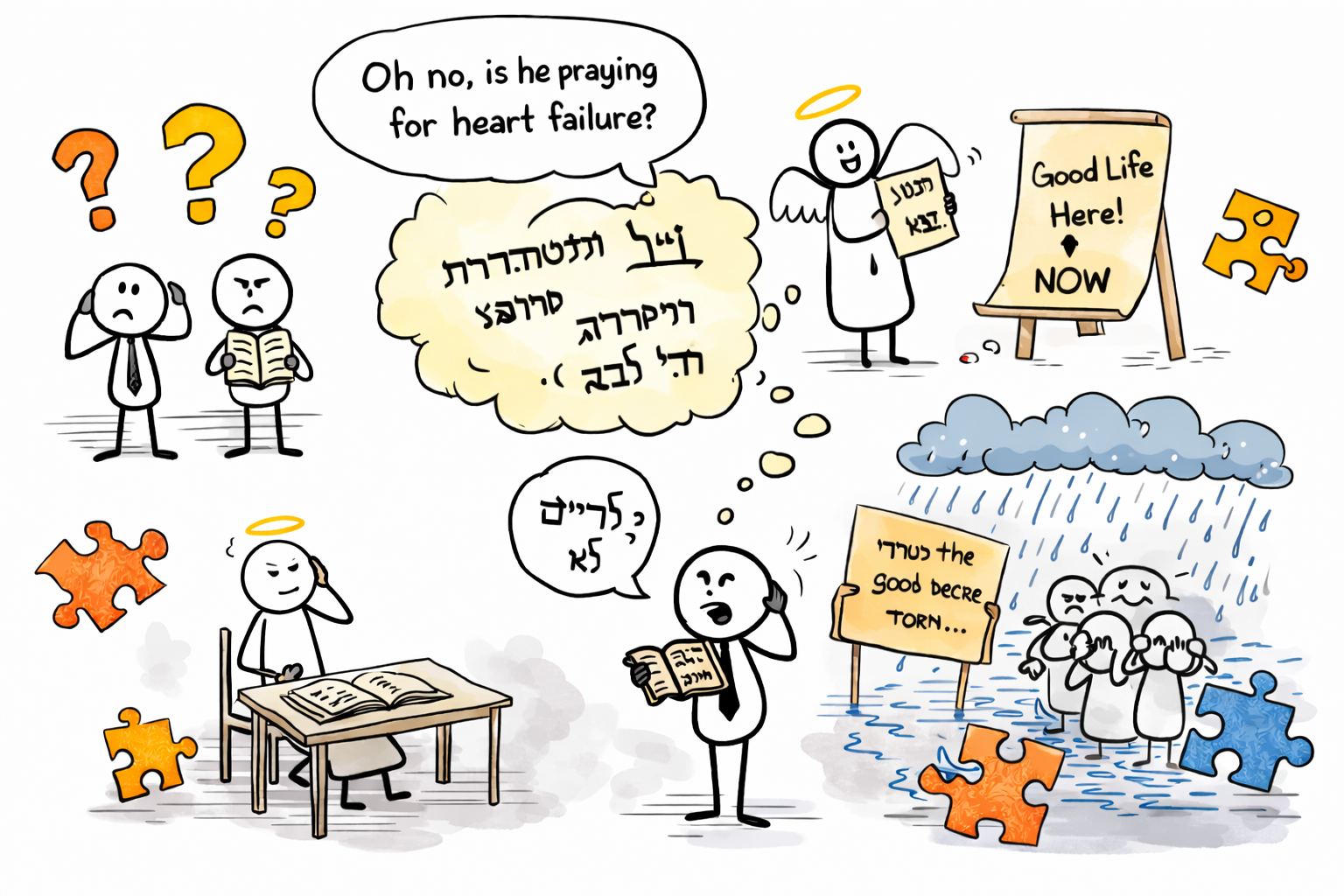
We've all heard “Be careful what you pray for,” but in Yiddishkeit, this concept is taken to extreme levels. The most famous example of this is the story of Choni Hame’agel (Taanis 23a). When he davens for rain at the behest of the Jewish people, initially, a couple of droplets drizzle down from some clouds. “לא כך שאלתי,” he beseeches. “We need enough rain to fill the wells.” So torrential showers suddenly pour down, threatening to flood the city (or even the world).
He turns to heaven once more. “That’s not what I asked for,” he calls out, “אלא גשמי רצון ברכה ונדבה.” The storm subsides and the rain begins now to fall in their typical manner, but they persist until the city of Yerushalayim begins to flood, and everyone congregates on the Har Habayis. Eventually, Choni pleads with heaven to stop even that rain, since it was too much for the world to handle.
This concept is not only relegated to stories from 2,000+ years ago. Our siddur is written with painstaking detail to avoid anything of the sort that could go wrong. When we daven for a good life, (and this is especially true during the Aseres Yemei Teshuvah) we are particular to say לְחיים as opposed to לַחיים, not (only) because of the grammatical distinction, but because the first syllable could possibly be mistaken by a listener as the Aramaic word לָא, and would sound like the request was for “No (good) life.”
Likewise, when asking Hashem to tear the evil decrees that may stand against us, we must be careful not to take a breath between the words רוע and גזר, lest the implication be that we are praying for the good of the decree to be torn as well.
There are many more such examples.
Now, respectfully, what is any of this supposed to mean? Are we suddenly pretending that Hashem has no idea what we want? Whatever happened to “הנסתרות לה’ אלקינו”, or “וה’ יראה ללבב”, or any of the other million places that Hashem makes it clear that He knows exactly what's going on in our minds? It's a literal pillar of our faith: “אני מאמין באמונה שלמה שהבורא יתברך שמו יודע כל מעשה בני אדם וכל מחשבותם.” But now, Hashem is only able to take us literally? When our prayers are answered in the form of a cardiac arrest, He’ll excuse himself, “Well, you asked for a golden heart!” If we mispronounce a word, He suddenly misunderstands the request?
I have a distinct memory from when I was in second grade. Our teacher once told us that the room was very messy, and that we needed to “pick up the floor.” All twenty-some eight-year-old boys happily began moving our desks out of the room as the first step towards being able to pick up the floor. (That was her first and last year teaching there.)
It makes sense for an eight-year-old to respond that way (and even then, absolutely aware that the response has little to do with the intent of the request), not for the Almighty and all-knowing being that created us.
So what is this game all about? Enlighten me.