
In the morning Ben was already up. He was holding a mug, and steam came out. It reminded me of Totty’s coffee. Before Totty took me and Shim’l to school, he sat by the table with a cup. And a Sefer in front.
Today, Shim’l was going by himself with Totty. I opened the front door, and at the end of the street I saw Totty and Shim’l’s backs. They were crossing the street.
I ran to get my satchel. Ben stuck his hand out. “Today you are coming to work with me.”
I wanted to go to school. I wanted to walk on the carpet of the staircase. I wanted to see the glass windows of my classrooms, the ones that were purple, the ones that had rectangles on them.
I twisted the door handle. “Berl, you forgot something,” I heard Ben saying behind me. “What did your Totty say?”
He had blue trousers, not like Totty. And a light green shirt with creases. He was right. I couldn’t understand the blueprints. When I traced them it didn’t work. They were confusing lines and confusing squares. But the blueprints were becoming patient. They were waiting for me.
“We are leaving in a few minutes, Berl,” Ben said as he opened a newspaper above the counter. It made crunchy sounds and he looked inside of it.
In the hallway I saw a door. It was a cupboard with a lot of newspapers, and they were not cut. Under them there was a notebook, and the cover was orange.
The spirals of the notebook were thorny when I squished it. The first page said “Notes.”
The next page had a U shape and a square inside of it. The square of elter zeidie’s blueprints. Ben also understood the blueprints.
“Berl?” I heard come from the kitchen. I slipped it back under and closed the door. “What are you doing?”
I went over to Ben. I gave him a paper and pencil. His eyebrows lifted, and his eyelids opened more.
We sat down by the table. He drew a figure. Then the diagonal line. “How can the figure get to the top?” I took the pencil and I erased everything. Then I drew a square like the one I remembered, the fourth corner connected to the wrong corner. It was completely wrong. It was worse than a circle. I looked at Ben.
He breathed faster, his shoulders were going up and down quickly. He concentrated his face. He touched his moustache.
“Let’s go, Berl.”
When we left, I looked at Donny’s lamps as we walked by them. One of them still had fire, but then it went out.
“What do you do with the square?” “Everything,” Ben said.
I looked at Ben’s shoes. They were old and worn out, black with a blue tint. Not as shiny as Totty’s or Reb Leib’s. But with the blueprints he can do everything. He can shine the shoes.
When we left our neighbourhood, I saw a tall building, taller than I’d ever seen. It had two towers, and each one had a clock. The clocks were completely round.
Above them were small domes, and on each dome stood a bird. Their wings were spread out, and their necks were skinny. The beaks stuck out, and there were thin metal rods holding them up.
And there were the waters of the Mersey. The last time I came here was when Uncle Dovid’s family went to America. I can still see them there. The place where I realized I wouldn’t see Yoich, Memi, and Yodel again.
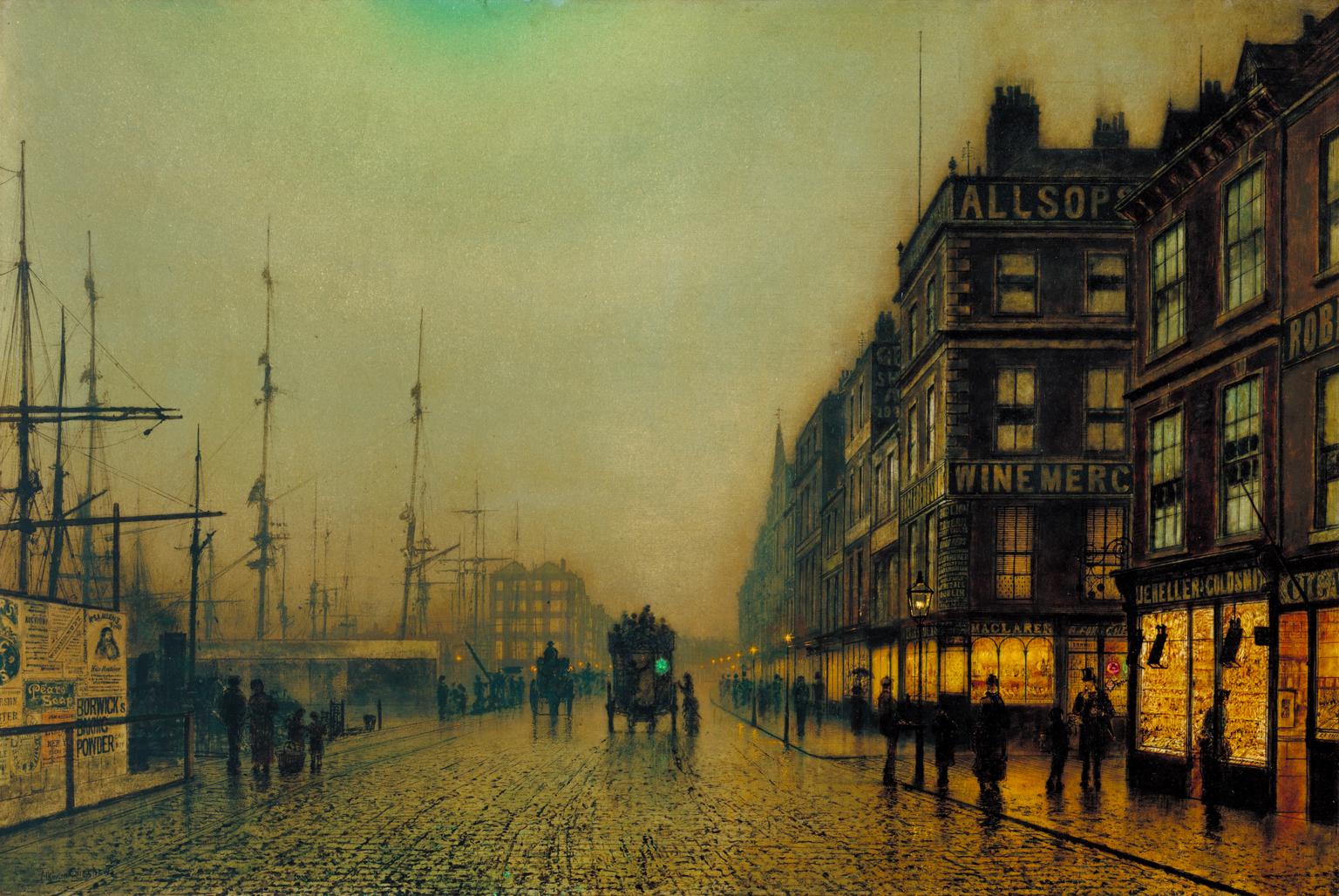
I saw lamps on the dock. That’s why we were last to get light. Donny started to light lamps here.
Then we arrived at the steel buildings that Tod spoke about. They had many chimneys, and there was black pouring out of them. “That’s where we are going, Berl.” The roof was rough, the walls were smooth. And the building stretched as far as my eye could see.
I was behind Ben when we came to the gates. Ben slid them open. A man with black smudges was sitting behind a desk. His eyes were on me.
Ben gave the man a card, and the man punched it twice. “Be careful, watch him!” the man said.
There was a plaque with an outline of a bird with outstretched wings on a door. The bird sat in its nest, flames licking its stomach. Its head was narrow and long, and its crest was sharp — coming out from the left.
Ben opened the door and the stench dug into my nose. It smelled like coal, magnets, and a steel ruler melting. The room was big and dark. The walls were muddy. The roof had a crane and a block moving on the tracks. Buckets were hanging from it, and they moved slowly across the room.
Ben stopped at the back on the right. He put on gloves and an apron, and another worker brought a red chunk of metal. It was the brightest red in the middle.
He placed the chunk on top of a big metal table, and pulled a lever which brought down a tower from the roof. It squished the metal, and when he opened it, the metal was a small U shape.
The table behind him had stacks of the formed pieces. Ben passed me thick gloves and asked me to check if there were cracks on them. “But wait until the brackets cool down. They are support for the bridges.” I didn’t put on the gloves yet.
I picked one up from the side, it was warm, and it felt a little scratchy. I saw a little number engraved on the inside. Two thirty eight. The bracket didn’t connect fully, like the square.
There were no cracks on this one. I put it down against the other ones. It made a thud.
Ben finished another bracket and dropped it on the pile. It had a little red glow. I put on my gloves. I looked all around it, trying to find a crack. There were none. I pulled on both edges. And then… it bent. The two sides spread apart from each other. I looked for the numbers, they were stretched. I couldn’t read them.
There were many things I couldn’t read. In the painting of the river at home, I couldn’t read the name on the bottom. The letters were stretched.
I wanted to push it back together, but I couldn’t. It was two arms spread apart. They were calling for help. I tucked the one with open arms underneath the pile.
Ben dropped another one on top of the pile. I slowly tugged at both sides. The more it bent, the harder it got. Until both ends met on the other side.
I moved it back a little, and now it looked like a perfect bracket. It was just flipped. I blew on it. It was hard. I put it on top of the other ones. Then I did the next one. And the next.
A tall, slim, and fancy Tod approached Ben. He was holding his pad.
“How are my brackets for my bridge?” Tod said as he patted Ben on the back. “Great, we got about a hundred and fifty done so far. And a boy is keeping it all in order.”
Tod looked at me. “Oh.” “You’re Beral, am I right?” Berle, but I nodded.
His suit was navy, there were no lines. He went up to my table and picked up a bracket. He scrunched his forehead. “Wait a minute…” he said.
He rushed over to Ben. He pointed repeatedly at the part of the bracket that was supposed to say the number and said “…labels, labels.”
Ben shrugged, and Tod started speaking faster. Ben pointed at me. “Beral, you didn’t bend the brackets while they were hot, did you?” “It wasn’t so hot,” I said, and the word “hot” got lost in a loud bang. Ben stopped and let go of the handle of his machine, slowly.
They are all fine. “Here,” I said, as I picked up one of the brackets from the pile to show Tod. It was one that I bent perfectly.
The open arms at the bottom caught on it, and the whole pile slid toward the edge. “Watch out!” Tod said as more brackets were falling off the table, one after another. I moved out of the way, and my foot stepped inside a bracket. It hugged my shoe.
Tod was busy moving all of the brackets to the side. And Ben went to get more metal. Nobody was looking at me.
On the wall near the table there was a door. The handle was a bracket. I took off my glove and felt it, it was cold. I tried pulling it, and the door opened.
Inside was a small room, and across it was a second door that looked like the front door to Ben’s house. It was tall, and it had six squares on it. Maybe this was Ben’s room? Ben saw elter zeidie. I went inside.
It was a staircase. In the middle of the stairs I checked under my shoe for the bracket, and it wasn’t there. When I reached the top, there was another door. It was an attic.
This attic was big, and the roof was tall. In my house the attic had a short roof. There was one man sitting in the corner, by a machine. He looked up, then looked back down. He was holding a blue paper. The paper had many white lines making all kinds of shapes and designs. It reminded me of elter zeidie’s blueprints.
“Young man,” he said. He was wearing an orange jacket. “My name is Daucel.” He was clean-shaven, and he wore a black cap. “What’s your name?” On the paper there were lines and shapes. “Berle.” And he was putting it into that machine. “That’s a fine name.” The machine was grey. It was etched with a maze, and it had pipes. The size of the machine I don’t remember. But it had a stick with a shiny red ball on the top. He pushed the stick forward and the machine grumbled.
The paper came out from the other opening. It wasn’t blue anymore, it was white. It was white like the light that came from Donny’s lamps. And there were colours.
He smiled. “I just finished building this. It’s to show the clients. It reads the lines off the sheet and fills in what a buyer wants to see. Sky, trees, the lot.”
“How does it work?”
“No need to know, lad.”
Daucel walked over to a wire and bent down. I took the paper that came out. It was a clear image of a brown building. It had things I didn’t see when it was a blueprint.
Now I could see all the details: the lines on the dome roof, the small arches by the windows. The black frames of the windows. The top and bottom of the pillars. And the sky, and the clouds. Trees around it. And they were all in the blueprint.
“A person has to bring a blueprint to life,” Daucel said. A blueprint made into life.
I looked at the side of the machine where the blueprint went in. It wasn’t there. “Where is the blueprint that went in?” I asked. “Ah,” he said. That’s all he said.
It was the same blueprint. It just improved.
The door opened. Standing there was Ben. “This is the wrong place, and the wrong time,” he said. One fist was closed, and in the other hand he was holding the bracket I couldn’t close. Around my eyes was a little wet.