
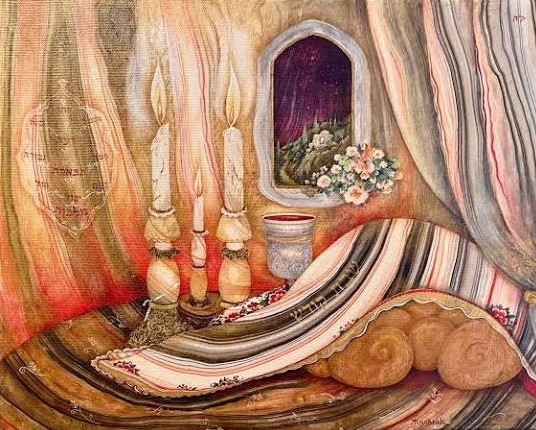
The Forgotten Princess
Shabbos is not a list of do's and don't's, it's an experience of holiness and divine intimacy.
In a recent article on this wonderful site the esteemed author wrote about two very important issues, Tanya and Shabbos.
Tanya: the author raised concern about the implementation of the teachings of Tanya in our day-to-day life and struggles. How when a bachur struggles he doesn't turn to the Tanya for guidance and clarity. And that somehow, as much as people know Tanya, it's not seen as a practical sefer.
This is a very sad truth. A very unfortunate reality. We should keep in mind however that as much as a person will learn he will still never get rid of his yetzer hara and taavos which are part of the human condition. However, the issue being discussed is not that we don't have a bunch of beinonim walking around. The issue is that, to an extent, Tanya is not even seen as the place to turn. This is a very painful issue, and I am grateful the author brought it up. Hopefully, it will bring a hisorerus to the learning and implementation of Tanya. There can be many reasons for this, perhaps it is that the way Tanya is taught to bachurim, perhaps it is the unattainable standard of Tanya (beinoni), perhaps it is more subliminal, the general “vibe” bachurim get in yeshiva, it could be many things and it there's no point in pointing fingers. What matters is learning Tanya, לימוד המביא לידי מעשה.
Shabbos: the author expressed deep pain about Shabbos, that many are sick of Shabbos and just wait for it to end, every single week.
Firstly, we don't understand other people's struggles and we have no clue what people are going through. So we can never chas veshalom judge anyone who is having a hard time with Shabbos.
Secondly, the author mentioned that people who start keeping Shabbos later in life seem to be happier with it. This applies to many things in yiddishkeit, as we see by many baalei teshuva that they have more excitment in many parts yiddishkeit than people who grew up with it. In general something that you grew up with has a different feel than something new, new things are always more interesting and fun. So yes, perhaps many people who only start keeping Shabbos later in life are happier but that doesn't mean that someone who grew up with it can't find joy and meaning in Shabbos.
:לגופו של ענין
I think it's fair to assume that the reason many people unfortunately lack interest in Shabbos is because they never really knew what Shabbos is about.
Shabbos is not a list of do's and don't's, it's an experience. A day to experience holiness, closeness to G-d, divine intimacy. Chassidus teaches us that on Shabbos the worlds are “elevated”, on shabbos even the food is a mitzvah. During the week, the neshama yearns to be close to G-d, but it's stuck in the mundane reality of this world. On Shabbos, the neshama can finally break free from its prison, למהוי אחד באחד, and experience g-dly delight.
This is what Shabbos is meant to look like. Obviously, this doesn't happen in one day and it can take a long time for a person to come to appreciate this. However, knowing this alone, that Shabbos is day to experience g-dliness, can change someone's perspective of Shabbos.
It's already Thursday.
Shabbos is coming!
Good Shabbos!
Shabbos, my Shabbos, heiliger Shabbos, your shame and disgrace have wounded my heart...