
Looking Again at a Familiar Story
We grow up, but some things tend to get left behind
We often read familiar stories at face value, without thinking about them even slightly — even when all the relevant details are sitting there, waiting to be noticed.
That is what is going to happen when these stories have been told to us incessantly from before we can even remember ourselves. But as we grow older, it becomes our responsibility to come back to them and ask what is actually happening here.
This is not, obviously, an attempt to replace what came before us. It is an addition — an aside, a theory, for those who want it. This is very much a “take it or leave it.” You don't like it? That's fine. Some people do.
What follows is a theory. Is it true? It might be. But that isn’t really the point. It’s interesting. It’s illuminating. Is this actually how it happened? That's not important. The purpose is to open your mind to possibilities you may not have considered before.
The main thing here is not to suffice with the way you have understood these things until now. Allow your understanding to grow together with you, together with your understanding of the world. What is the purpose of an expanding mind and a developing worldview if not to develop your understanding of Torah?
We learn Chumash year after year, and it is not in order to revisit the stories with a five-year-old’s mind again. We grow up. Our perception of these stories must grow as well. Otherwise, we are left with an adult's understanding of the world and a toddler’s understanding of Torah.
If you don’t like the way I am doing this, no problem. Do it yourself. Make your own. But use your head. Understand what you have been taught. Comprehend what you have been told.
With that in mind, come with me to Egypt. The year is 2255 from creation.
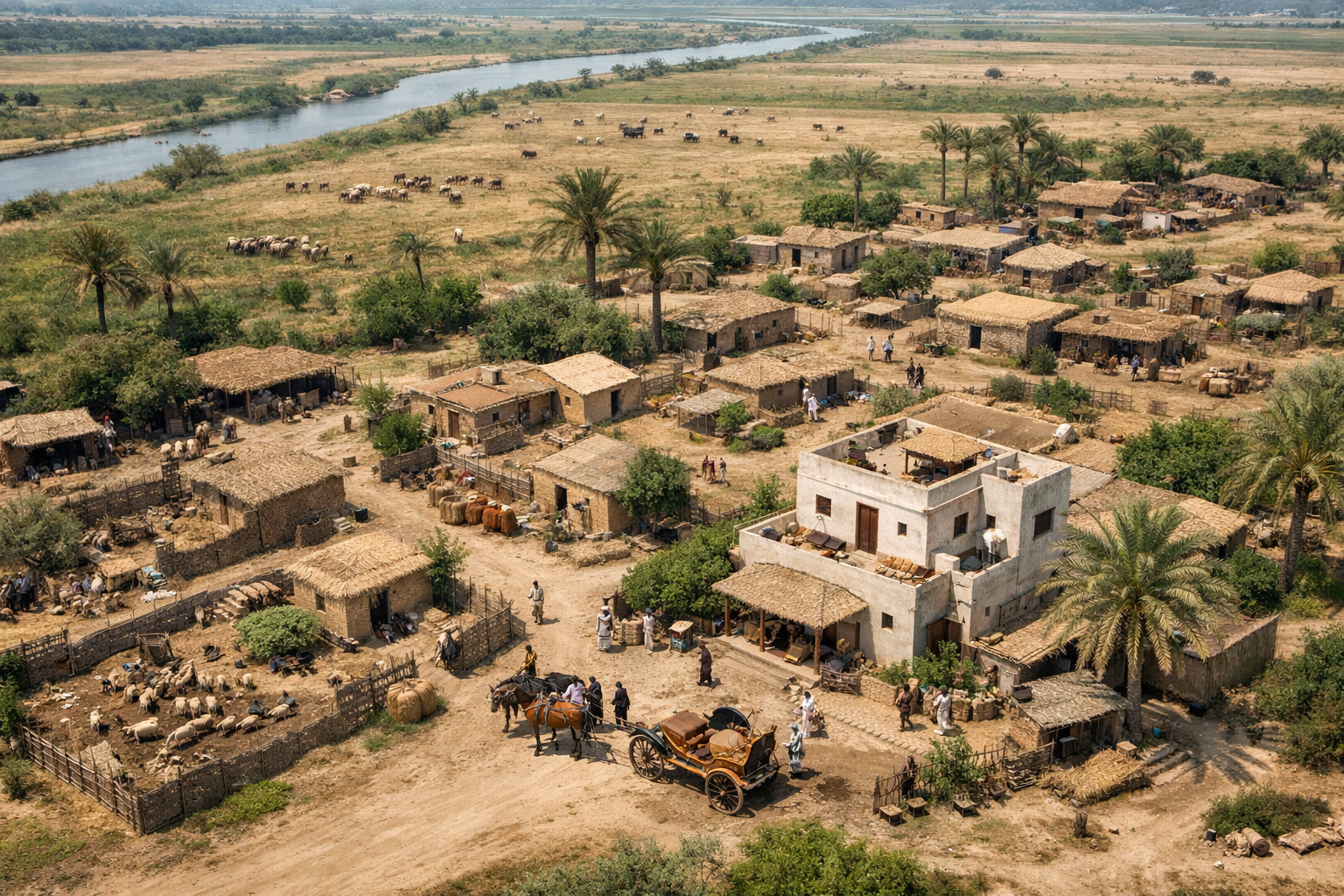
The royal carriage stands out in the suburban neighborhood of Goshen, on the eastern edge of Egypt. It belongs more naturally in the capital, Memphis, among the mansions and palaces of Egypt’s elite, clustered near the outer edges of the royal compound. Here, it looks out of place.
It waits among low mudbrick homes with thatched awnings, each spaced generously apart. The lanes between them are more path than road, clearly not frequented by wheels and chariots. Beyond the final row of dwellings, herds graze in flat pasture that stretches toward the canal. In this quiet corner of the delta, the viceroy’s magnificent carriage stands still — one servant holding the reins, another armed and silent beside the step — outside the only two-story home in the neighborhood.
The viceroy of Egypt — who is, for all intents and purposes, Pharaoh himself — has come to visit his aging, ailing father. With him he has brought his two sons, Menashe and Ephraim, to be blessed before it is too late. The room in which they stand is quiet and shaded: a high-ceilinged chamber with thick, whitewashed walls, cooled by a breeze drifting in from the open courtyard. Near the far wall sits a low bed, where Yaakov lies propped on cushions, his eyes dim with age. A reed mat softens the clay-tiled floor beneath their feet. A single clay oil lamp flickers in a wall niche, and from outside comes the distant sound of sheep bleating.
Yosef positions his sons carefully — Menashe on his left, so he will stand beneath Yaakov’s right hand, and Ephraim on his right, to face Yaakov’s left. But as Yosef draws them close, Yaakov crosses his arms. He places his right hand on Ephraim’s head, the younger, and his left on Menashe.
Yosef is startled. His father begins to bless them, and Yosef reaches out, grasping his father’s hand to move it. “לא כן אבי, כי זה הבכר, שים ימינך על־ראשו — I already put menashe on your right, because he is older.” he says. But Yaakov refuses. “ידעתי בני ידעתי — I know he's older,” he says. “But his younger brother is going to become a greater nation.” And so the hands remain crossed as he blesses them that day.
So far, all this is just the way we’ve understood the story as children.
There is though, might I posit, another dimension to this conversation. But first we must understand a bit more about these two sons.
Seventeen years earlier, ten brothers found themselves in a foreign land for the first time in decades. Reduced to seeking sustenance rather than providing it, as they had long been accustomed, they arrived already in pretty low spirits.
Then the viceroy of Egypt, the formidable Tzafnas Paneach, accused them of espionage.
They were caught completely off guard. They argued with him. They defended themselves. They insisted on their innocence. The viceroy did not relent. He pressed them again and again, about their origins, their homeland, their family.
Every sentence, every accusation, every denial was duly translated to the proper party. The brothers spoke no Egyptian, and the viceroy, it appeared, spoke no Hebrew. The exchange was mediated seamlessly by the royal court’s interpreter, a man thoroughly fluent in both language and protocol.
That interpreter was Menashe.
He stood between them — between Yosef and his brothers — calmly translating their heated exchange. He heard them speak of their family, of a missing brother, of a father left behind in grief. And he stood there, unmoving, careful not to divulge even the slightest revelation beyond what his father intended.
When Yosef decided that one of the brothers would be kept in prison while the others returned home to feed their families, he chose Shimon. This was no trivial decision. Shimon was not known for restraint, and it was precisely for that reason that Yosef deemed it necessary to separate him from his brothers. Detaining him was not a clerical task. Shimon had no intention of going down quietly. It required force.
The man entrusted with this assignment was strong enough, composed enough, and authoritative enough to carry it out swiftly. There was no prolonged struggle. The brothers watched, stunned, as Shimon was taken away, powerless to intervene.
Yosef did not summon guards at random. He sent one man.
Menashe.
Always at his father’s side, Menashe had been trained from a young age in the etiquette and discipline of the palace. Beyond serving as the court interpreter, he oversaw the management of Egypt’s second most prestigious residence and its surrounding compound. And when necessary, he was the strongest man in the palace. Menashe worked closely with his father on a daily basis.
Ephraim, on the other hand, was hardly there.
Before Yaakov ever came down to Egypt, he sent Yehuda ahead to establish the framework that would allow the family to continue the life of learning they had led until then. When they arrived, the group that learned with Yaakov consisted of his sons and grandsons who had come with him from the Land of Israel, doing in Egypt exactly what they had done there.
With one notable exception.
There was a single representative from the capital who learned with Yaakov on a regular basis: the younger son of Yaakov’s favorite — Ephraim.
When word needed to reach Yosef urgently — that his father was ill, and that if he wished to ensure his sons would be blessed by him, he must come at once — Ephraim was already at his grandfather’s side, ready to be sent for whatever was required. He had been there for seventeen years, day after day, learning directly from Yaakov, and he was willing to do anything for him.
Even if it meant the exhausting journey from Goshen to Memphis, forty-some miles each way, covered at speed by a trained rider, a full day’s hard travel in each direction, Ephraim would go without hesitation. If it was for his grandfather, nothing else mattered.
Now, standing before him, Yaakov sees the two grandchildren, and the contrast between them.
Naturally, he places his right hand on Ephraim, even if the positioning is unnatural. Yaakov knows him well. He recognizes him, and sees the future in him.
Yosef, however, protests. He asks his father to place the primary bracha on the son he himself knows best, the older one, the one he raised, the one he trained daily.
In other words, the conversation between Yaakov and Yosef was not only a difference in the way they saw the grandsons' future promise and potential, but also about what their past actions had already earned them.